
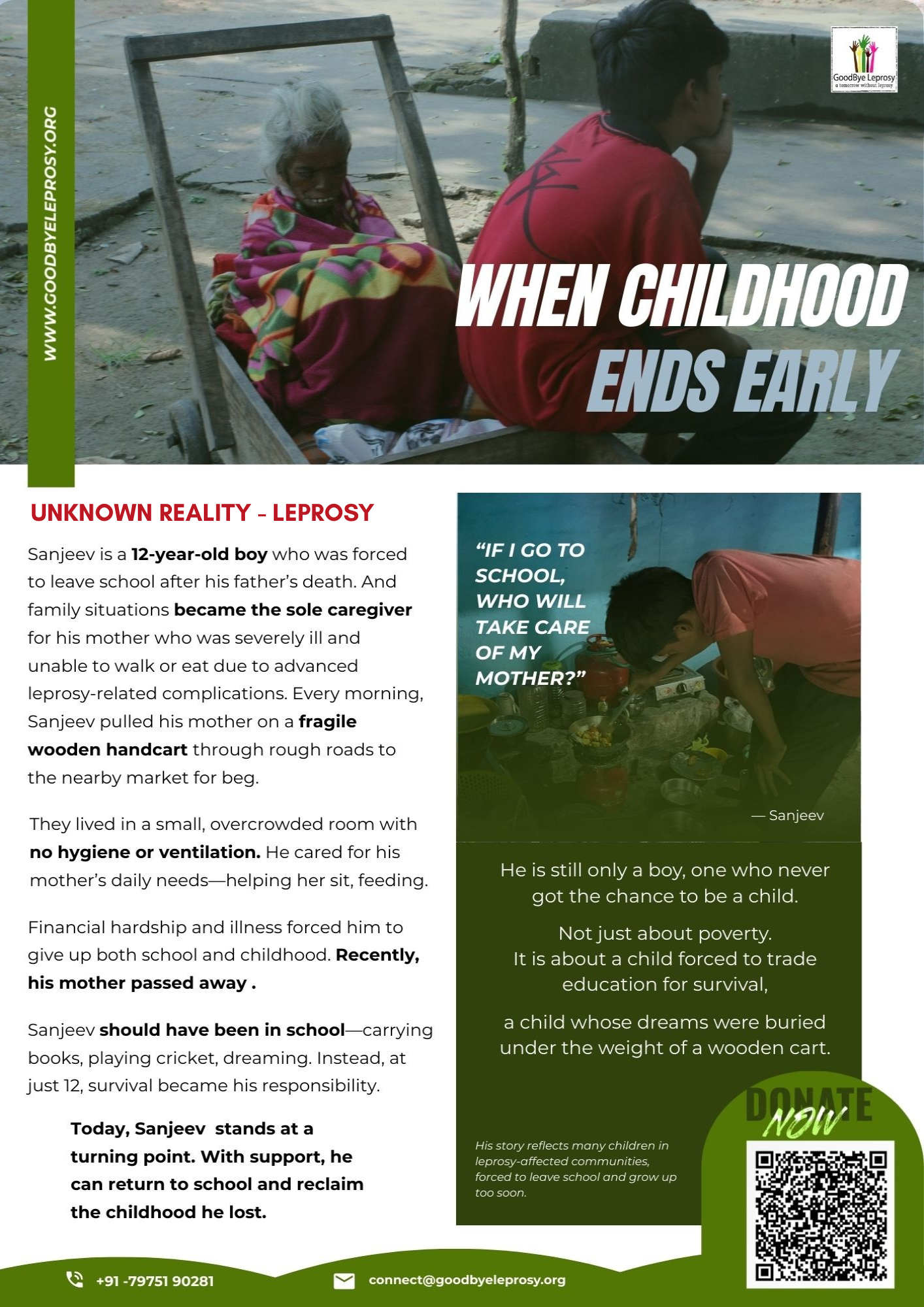
Sanjeev is a 12-year-old boy who had to leave school after his father passed away. With his father gone and the family struggling, Sanjeev became the primary caregiver for his mother, Pushpa Devi, who was severely ill and unable to walk or eat properly due to her advanced leprosy-related complications.
Every morning, Sanjeev placed his mother on a small wooden handcart and pulled her to the nearby market area where she begged for a few rupees. The cart was made of loose pieces of wood tied together, and Sanjeev had to pull it through rough, uneven roads. He did this because there was no one else who could take her.
At home, they lived in a small, crowded room shared with his elder brother and young sister-in-law. There was no space, no hygiene, and no proper ventilation. Sanjeev often handled his mother’s basic needs, helping her sit, feeding her whatever she could swallow, and keeping the room as clean as he could.
When asked if he wanted to return to school, Sanjeev said he wished he could, but added
“If I go to school, who will take care of my mother?”
His elder brother worked in the mining area and could not take responsibility. Because of the family’s financial and physical limitations, Sanjeev’s education and childhood came to an abrupt stop.
Recently, his mother passed away due to her deteriorating condition.
Sanjeev’s story reflects the challenges faced by many children in leprosy-affected communities, children who are forced to drop out of school and take on adult responsibilities far too early because of illness, poverty, and lack of support.
Sanjeev should have been in school.
He should have been carrying books, running behind friends after class, fighting over cricket, laughing, learning, and living.
But Sanjeev’s childhood ended the day his father died.
He was 12 years old when the burden of survival fell entirely on his small shoulders.
Now, Sanjeev stands at a turning point.
He is still only a boy, one who never got the chance to be a child.
His story is not just about poverty.
It is about a child forced to trade education for survival,
a child who carried a responsibility too heavy for his age,
a child whose dreams were buried under the weight of a wooden cart.